
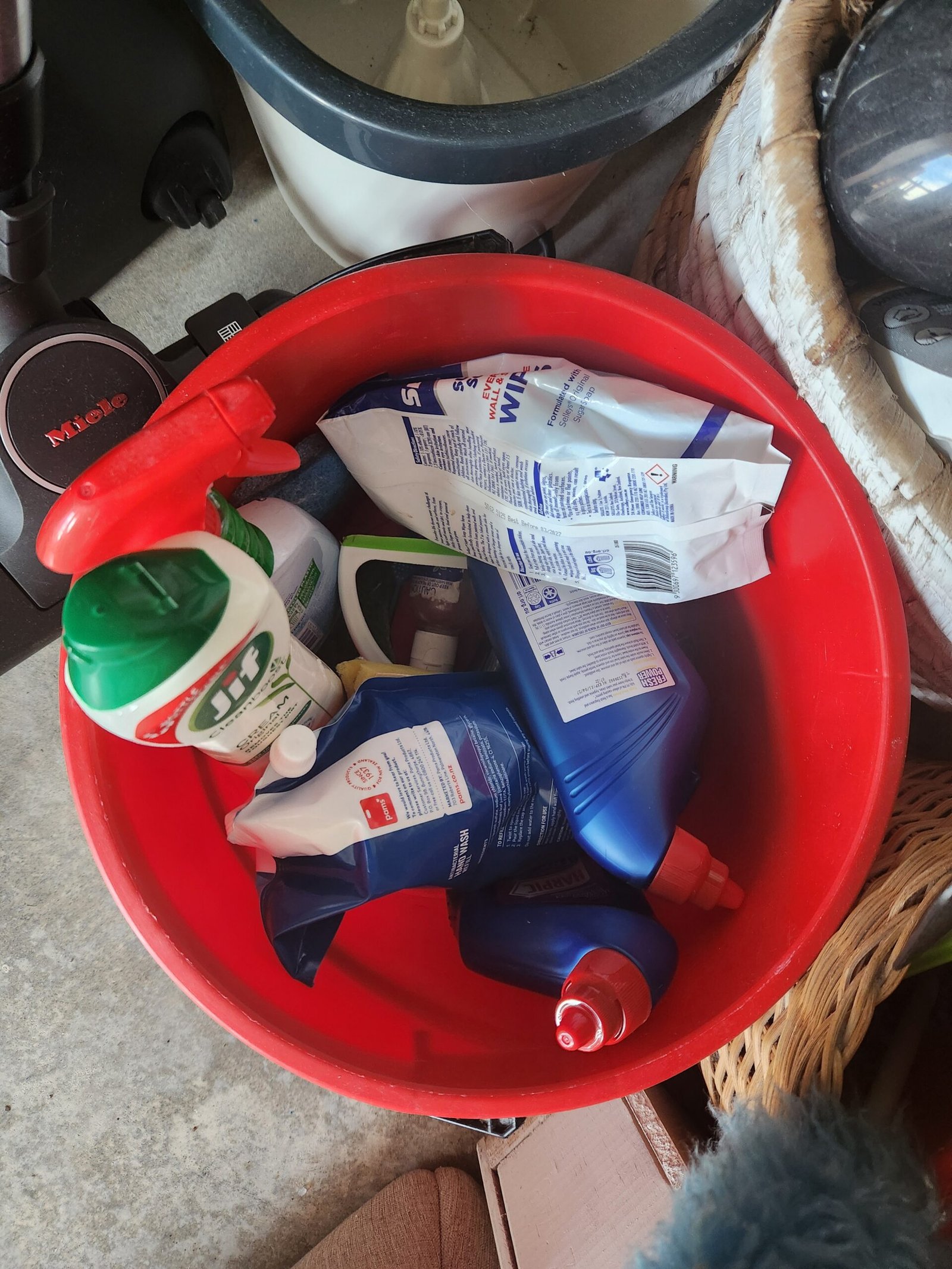
Most household cleaners are safe and useful when they are used exactly as directed. The problem begins when products are mixed, sprayed too heavily, used in a closed room, left where children can reach them, or left on a surface that the label says must be rinsed.
Bleach, glass cleaner, cream cleansers such as Jif, disinfectant sprays, multipurpose cleaners and oven cleaners do not all work in the same way. They also do not share one universal rinsing rule. The correct method depends on the formulation, the surface and the current Australian label or safety data sheet.
The safest rule: never improvise a mixture, never assume “more” means “cleaner”, and read the label every time you change products.
Why ordinary cleaning products can cause real harm
A product does not need to be “industrial strength” to cause an injury. Household bleach commonly contains sodium hypochlorite; some oven cleaners are strongly alkaline; and many sprays contain solvents, surfactants, fragrances or disinfecting actives. Depending on concentration and exposure, these can irritate or burn skin and eyes, affect breathing, damage a surface, or leave unwanted residue.
Victoria’s Department of Health warns that bleach must not be mixed with ammonia, acids or other cleaners because hazardous chlorine or chloramine fumes can be released. That includes acidic toilet cleaners and vinegar—not just products labelled “acid”. Victorian Department of Health
Poor ventilation increases inhalation exposure, particularly with sprays and volatile products. Open doors or windows where the label directs, use the smallest effective amount, and never lean into an oven or shower recess while spraying.
Which cleaners need rinsing?
There is no reliable rinse/no-rinse rule based only on a product category. Two multipurpose sprays can carry different directions. A disinfectant may need to remain visibly wet for a specified contact time before wiping, while another may require a potable-water rinse on food-contact surfaces. Always follow the specific pack you hold.
Bleach and bleach-based bathroom or mould cleaners: usually rinse
Current Australian bleach labels commonly direct users to dilute or apply the product, allow a specified contact time, then rinse thoroughly. For example, Coles Ultra Laundry Bleach directs users to rinse treated kitchen, bathroom and laundry surfaces after ten minutes. White King bleach directs rinsing after bathroom use, and current bleach-based mould-remover labels also specify rinsing.
Bleach can discolour fabrics, corrode incompatible metals and damage stone or worn enamel. Never transfer it to a drink bottle, never mix it with another cleaner, and prepare only the dilution stated on the label.
Jif and other cream cleansers: rinse thoroughly
Cream cleansers combine surfactants with fine abrasive particles. They are useful on compatible hard surfaces, but product and soil can remain if the area is only dry-wiped. Unilever’s current Australian instructions for Jif Professional Cream Cleanser say to rinse the cleaned area thoroughly with water. They also advise testing delicate materials, rinsing immediately and avoiding heavy rubbing. Unilever Professional Australia
That does not mean every cream cleanser is suitable for every sink, cooktop or benchtop. Check the label and the surface manufacturer’s care instructions, especially for natural stone, coated finishes, aluminium and painted surfaces.
Glass cleaner: normally wipe dry, not rinse
Ready-to-use glass cleaners are generally designed to be sprayed sparingly onto glass and wiped with a clean, lint-free cloth until dry. Rinsing would usually defeat the streak-free purpose. Do not assume the same product is suitable for stone, screens, tinted film or food-preparation areas. If overspray lands on a food-contact surface, follow the label; where the product is not approved as no-rinse for that use, wash and rinse the area before food touches it.
Multipurpose cleaners: wipe or rinse according to the label
Some ready-to-use multipurpose cleaners are designed for spray-and-wipe cleaning on sealed hard surfaces. Concentrates usually require measured dilution, and some applications require a rinse. The surface matters: a floor, a painted wall and a kitchen chopping area are not interchangeable uses.
Using extra concentrate can increase residue without improving the result. It can also make floors slippery and increase skin or breathing irritation. Measure rather than guess.
Disinfectant sprays and wipes: respect contact time
A disinfectant needs the label’s stated contact time to achieve its registered claim. Wiping it away immediately may make that claim unreliable. Conversely, leaving a product indefinitely is not automatically safer and may damage the surface or create residue.
First remove visible dirt where directed. Apply enough product to keep the surface wet for the labelled time. Then wipe, rinse or allow to air-dry exactly as instructed. Never combine disinfectants in an attempt to make them “stronger”.
Oven cleaners: remove the residue carefully
Many heavy-duty oven cleaners are strongly alkaline and can cause serious eye or skin injury. The current Australian Easy-Off Oven & BBQ Everyday Cleaner safety data sheet identifies it as a kitchen cleaner/degreaser and directs appropriate protective measures. Oven-cleaner directions typically require the dissolved soil and product to be wiped away with a wet sponge or cloth—often repeatedly—until no residue remains. Reckitt Australian SDS, 9 October 2024
Use only on surfaces listed on the product. Keep away from heating elements, pilot lights and incompatible finishes, and ventilate as directed. Do not turn the oven on until the label’s cleaning and residue-removal steps are complete.
Food-contact surfaces need special care
A benchtop, chopping board, high-chair tray or refrigerator shelf needs a more careful decision than a window. Food Standards Australia New Zealand explains that food utensils and surfaces should be cleaned before sanitising and that detergent should be rinsed off. FSANZ cleaning and sanitising guidance
Use only a product intended for that surface and purpose. If the label requires a potable-water rinse, do it after the full contact time. If the product is explicitly labelled as no-rinse for food-contact use at a stated dilution, follow that dilution precisely. “No-rinse” is a formulation-specific instruction, not a general claim about all disinfectants.
Five habits that prevent most cleaning-chemical mistakes
- Keep products in their original containers. The label, first-aid directions and child-resistant closure matter. The ACCC advises storing cleaning products securely and never transferring chemicals into used drink bottles.
- Use one product at a time. Rinse away the first product where required before using a different one.
- Ventilate and control spray. Spray onto a cloth when the label permits, particularly near faces, electronics or confined spaces.
- Protect skin and eyes. Wear the gloves or eye protection specified on the label or SDS, and wash hands after use.
- Store chemicals upright and out of reach. Keep them away from children, pets, food, heat and incompatible products.
If exposure occurs
Move away from fumes and into fresh air if it is safe to do so. For chemical exposure to skin or eyes, follow the product label and seek prompt advice. Healthdirect advises cool running water for at least 20 minutes for a chemical burn and gentle eye irrigation for 20 minutes. Call the Poisons Information Centre on 13 11 26 for advice anywhere in Australia; call 000 for severe breathing difficulty, collapse or another emergency. Healthdirect: chemical burns
Safer cleaning is a system, not a stronger bottle
Good cleaning comes from choosing a fit-for-purpose product, using the correct dilution, allowing the correct contact time, ventilating the area and removing residue when required. It does not come from combining chemicals or using more than the label recommends.
Leave the product decisions—and the cleaning—to trained professionals
If you want a thoroughly cleaned Melbourne home without navigating multiple products, dilution rates and rinsing instructions yourself, Green Clean Melbourne can provide a tailored residential cleaning service. Our trained professionals select safer, fit-for-purpose products and use them according to the task, the surface and the manufacturer’s directions. Professional cleaning cannot eliminate every risk, but a careful system can reduce avoidable mistakes and deliver a more consistent result.
Sources
- Victorian Department of Health: After a flood—mould and your health
- ACCC Product Safety: Chemical and poison risks for children in the home
- Food Standards Australia New Zealand: Cleaning and sanitising
- Unilever Professional Australia: Jif Cream Cleanser directions
- Reckitt: Easy-Off Oven & BBQ Everyday Cleaner SDS
- Healthdirect: Inhaled substance or object